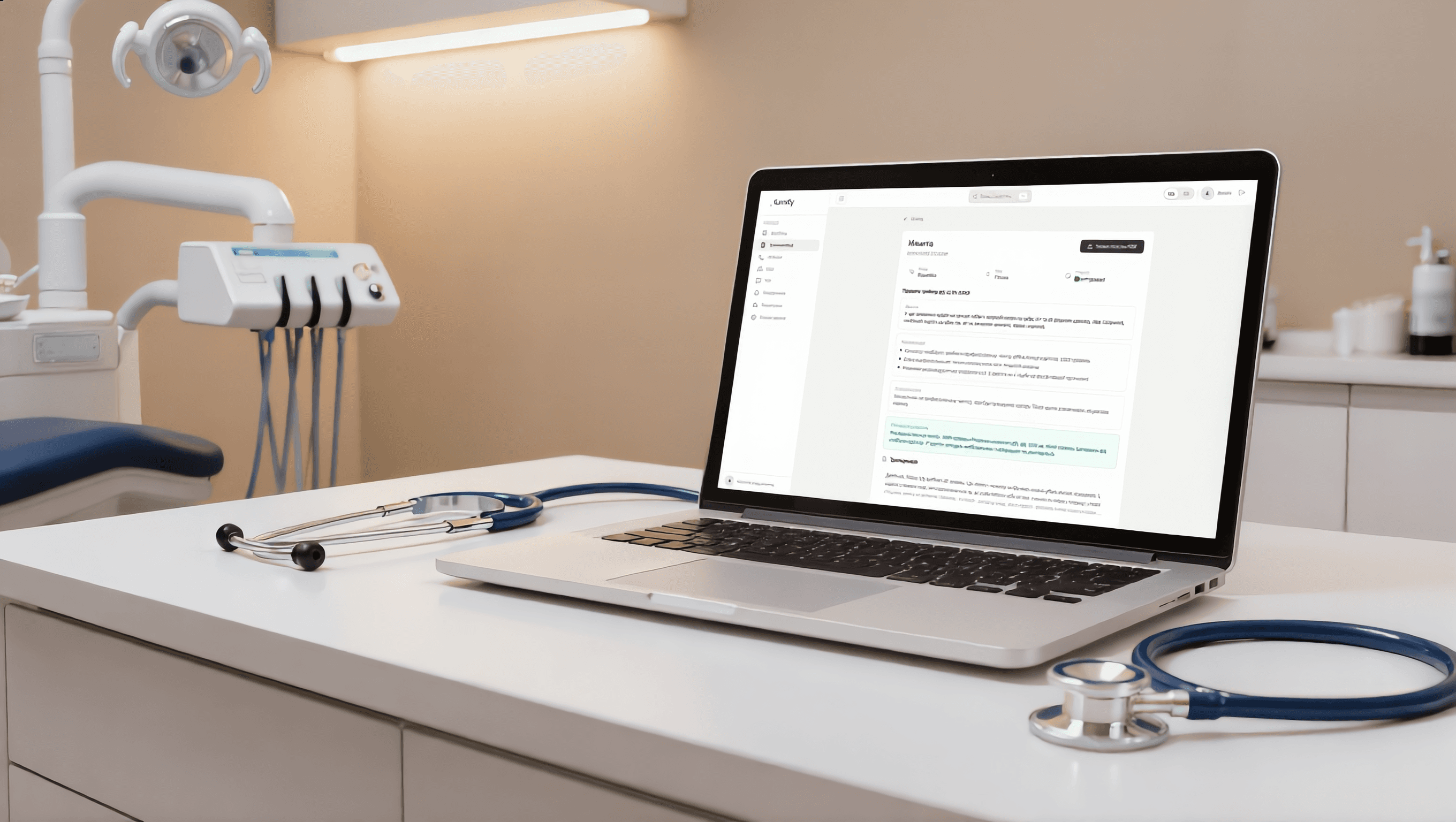
The doctor treats teeth. Then sits down to write notes. Every day. For years.
You just finished a complex appointment. The patient left happy. And you sit down at the computer and spend the next 15-20 minutes recalling what was said, what complaints were mentioned, what was prescribed.
Every dentist knows this routine. Over an 8-hour workday, 6-8 appointments turn into 2-3 hours of documentation. You spend a third of your working time not treating patients, but writing.
Not because you enjoy it. Because you can't practice without documentation. Medical records, treatment plans, ICD-10 codes, recommendations — all of it needs to be recorded.
What is AI visit transcription
Transcription means converting speech to text. AI dental visit transcription works like this: during your conversation with the patient, the system listens and records everything said.
But it's not just a dictaphone with a transcript. The AI analyzes the conversation and creates structured clinical notes: patient complaints, objective status, diagnosis, treatment plan, recommendations.
You don't need to speak in a special voice or use keywords. Just talk to your patient as you normally would. The AI figures it out.
What it looks like in practice
You start the appointment. On your desk (or phone) there's an app capturing the conversation.
The patient says: 'I have a toothache on the upper left, it's been a week, especially with cold things.'
You respond: 'Let's take a look. Tooth 26, I see a deep carious cavity, positive reaction to cold. I recommend a filling, if the X-ray confirms — possibly endo.'
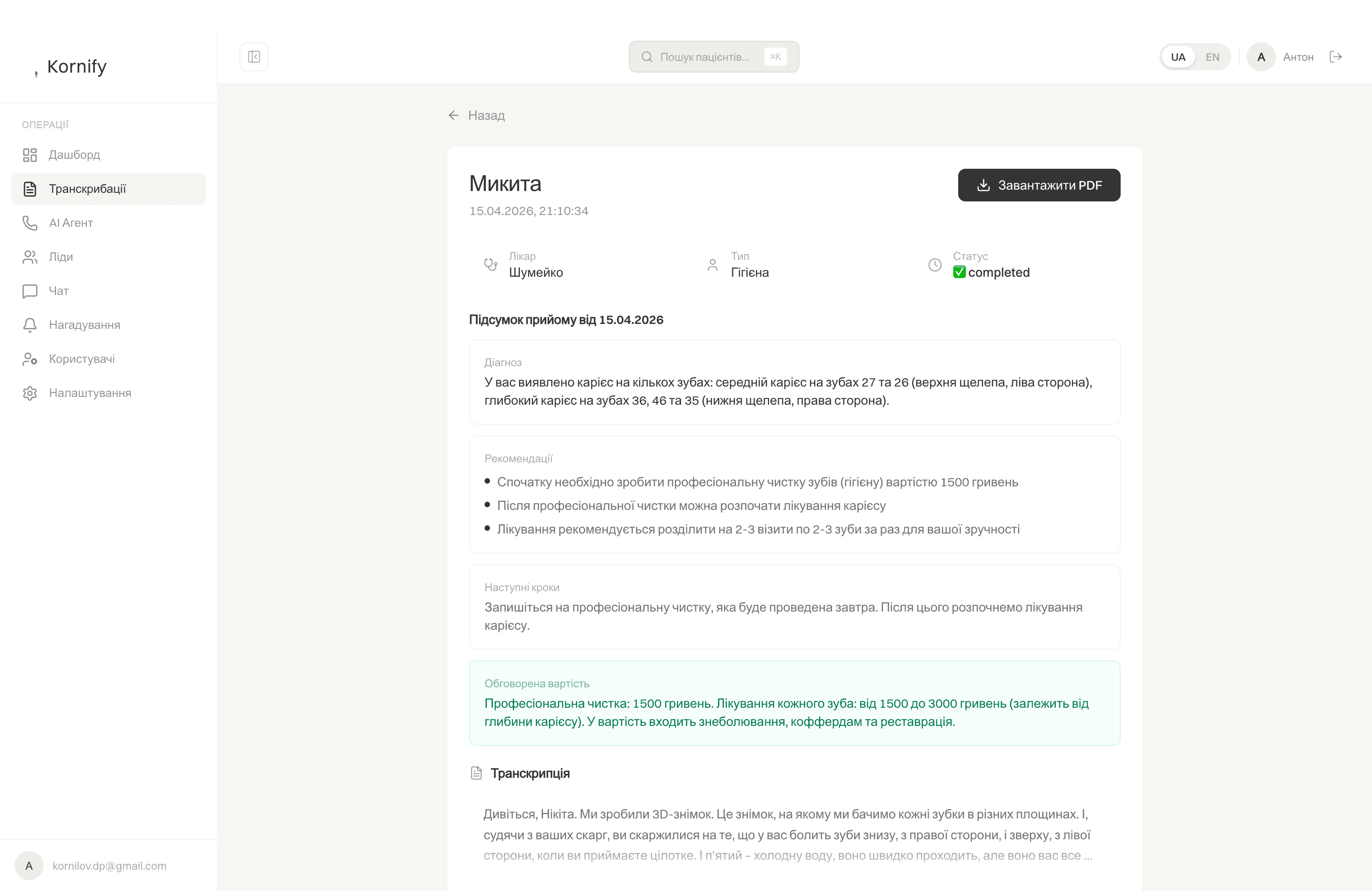
A few minutes after the appointment, you receive ready notes in PDF:
— Complaints: pain in tooth 26 area, one week, worsens with cold
— Examination: deep carious cavity 26, positive cold reaction
— Preliminary diagnosis: K02.1 (dentin caries)
— Plan: radiography, filling or endodontic treatment
— Recommendations: follow-up in 2 weeks
Language detection: Ukrainian, Russian, mixed
The reality of Ukrainian clinics — patients speak different languages. Some Ukrainian, some Russian, some mix both. The doctor may respond in a different language than the patient.
AI transcription automatically detects the language and works with both. Notes are generated in Ukrainian (or any language you choose), regardless of which language the conversation was in.
Medical terminology is also recognized correctly. The system knows the difference between 'pulpitis' and 'pulp,' between 'tooth 26' and 'twenty-sixth.'
Note format: PDF with ICD-10 codes
Ready notes arrive in PDF format. The structure follows standard medical documentation:
1. Date and time of visit
2. Patient complaints (patient's own words)
3. Objective examination (doctor's findings)
4. Diagnosis with ICD-10 code
5. Treatment plan
6. Recommendations
7. Next appointment scheduling
The PDF can be saved to the medical record, sent to the patient, or added to the clinic's CRM. ICD-10 codes are assigned automatically based on the conversation context.
2-3 hours per day. Every day. That's how much you save.
One appointment — 10-20 minutes of manual documentation. 6-8 appointments per day — 1.5-3 hours.
AI transcription reduces this to zero. Notes are ready within minutes after the appointment. All you need to do is review and confirm.
Doctors already using voice transcription say the same thing: 'I finally go home on time.' Instead of staying after the last patient to fill out records, you simply close the office and leave.
Data security: where recordings are stored
Voice data is processed on EU servers (Frankfurt, Germany). Call recordings are not stored permanently — they're automatically deleted within 10 minutes of processing.
Finished notes are stored in your database, protected with AES-256 encryption. Only authorized clinic staff have access.
The entire system complies with GDPR requirements. Each clinic's data is isolated from others.
How to implement in your clinic
For transcription, you only need a device with a microphone — laptop, tablet, or smartphone. No separate equipment required.
Setup takes one day. We adapt the system to your specialty: general dentistry, oral surgery, orthodontics — each has its own terminology.
After launch, you can start with one doctor, see the results, then scale to the entire clinic.
Next step
If you spend hours on documentation every day and feel that time could be better used, book a demo.
We'll show transcription in action: run a test appointment, generate a PDF with notes, and you'll see how it works with your specialty.